Shavuot (Hebrew) or Pentecost (Greek) was originally an agricultural holiday that marked the wheat harvest in the Land of Israel. (Exodus 34:22) The word Shavuot means “weeks”, and it marks the conclusion of the counting of the Omer, 49 days (7 weeks) after the Exodus from ancient Egypt. It is also referred to as Pentecost due to its timing after Passover, “pentecost” meaning “fifty” in Greek, since Shavuot occurs fifty days after the first day of Passover.
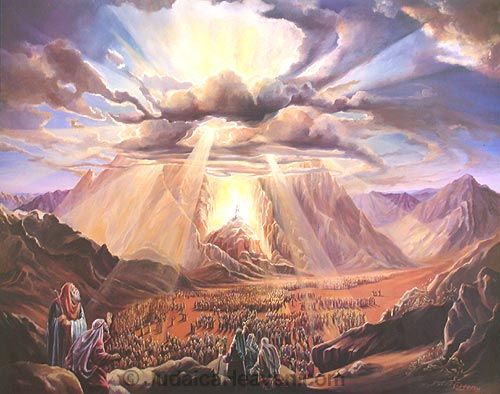
According to Jewish tradition, Shavuot also marks the date when Moses received the Law, and it is celebrated as such by religious Jewish people today. The giving of the Torah (the first five books in the Hebrew Bible) to Moses at Mount Sinai is not as well-known among non-Jews as Passover or Sukkot, the Feast of Booths, yet it is one of the three major festivals often called “pilgrim” festivals because in Bible times, all Jewish males were required to observe them at the Holy Temple in Jerusalem.
The two holidays, Passover and Shavuot, are linked by more than just their proximity. The Exodus from Egypt, which Passover celebrates, marked the beginning of physical freedom for the Jewish people. But Shavuot is a reminder for the Jews that physical liberation was incomplete without the spiritual redemption represented by receiving God’s Law.
Shavuot is also called Atzeret, meaning “the completion,” because together with Passover it forms the completion of a unit. Jews gained their freedom from Egypt on Passover to receive the Torah on Shavuot. It was literally where heaven met earth!
The Torah reminds us that there is such a thing as right and wrong in God’s eyes. He cares enough to give us a glimpse into his Holiness. (Leviticus 19:2) It is impossible for even the most pious human being to keep God’s law perfectly, – we all mess up. Nobody can keep the 613 dos and don’ts. The Almighty didn’t give us the Law to make us perfect, but to show us His perfection!
The two tablets engraved with the 10 commandments bear comparison to the ketuba – the wedding contract a groom gives to the bride.
For Christians the Torah is synonymous with the 5 books of Moses in their Old Testament, but many view them as unnecessary. They don’t understand that they are foundational to the New Testament and were read by Jesus himself in the Temple in Jerusalem. They fail to understand that by celebrating this holiday they practice the same traditions and rituals that Jesus embraced. – Biblical holidays are nothing less than God’s appointed times.
Shavuot is celebrated by presenting an offering of two loaves of new grain to the Lord. (Lev.23:16-17) Why two loaves? Two represents the unity between Word and Spirit, heaven and earth, body and soul, Jew and Gentile. In the book of Ruth, we see the power in the unlikely marriage between Boaz, the Israelite, and Ruth, the Gentile.
Shavuot represents not only unity, but also the unification of opposites. The same language ‘Rashi’ used to describe the love and unity that existed among the people of Israel who camped in the wilderness, right in front of at Mount Sinai.
Shlomo Yitzchaki ( רבי שלמה יצחקי); 22 February 1040 – 13 July 1105, today generally known by the acronym ‘Rashi’, was a medieval French rabbi and author of a comprehensive commentary on the Talmud and commentary on the Hebrew Bible (the Tanakh)
 Standing with Israel