The song originated in Europe at the end of the 19th century. In many versions of the game, a group of children forms a ring, dances in a circle around one person, and then falls down on the final line. The slowest child to perform this action usually becomes the “rosie” (literally: rose bush, from the French rosier), taking his or her place in the center of the ring.
Recently I was reminded of that childhood song following the current news cycle, as the West attempts to bulldoze impossible peace scenarios into existence between Israel and its jihadi neighbors, without fully understanding the ideology of Islam.
Most Israelis realize that Western super-power pressure merely postpones jihadi hostilities to a coming conflict, and that Iran’s proxies would live to fight another day against the sons and daughters of Jacob. Intensive attacks on the enemy are followed by periods of “talks” with inconclusive results.
The latest example comes from senior US officials on as they attempt to transfer Hamas’ jihadi weapons to the terror gangs of the PLO/PA. Dancing around the issue of protecting God’s covenant land from the Islamic enemy and falling short of a workable solution.
Some Israelis had high hopes in July 2006 when IDF tanks rolled into Lebanon. Today some American diplomats are similarly declaring: “Certainly this time we’re going to succeed in reducing the forces of both Hamas and Hezbollah!” – Yet the problem remains, the Iranian proxies are still here.
Ezekiel (13:10-16) rebukes anyone who builds a wall with white-washed plaster over it and proclaims peace when there is no peace.
As Islam infiltrates the West and the world sinks into darkness, it is important that we understand the times and prepare for the challenges ahead.
Over 2,700 years ago, Isaiah prophesied: “The earth is also defiled by its inhabitants, for they violated laws, altered statutes, and broke the everlasting covenant. Therefore, a curse devours the earth, and those who live on it suffer for their guilt” (Isaiah 24:5-6)
Remember the American TV game show “Let’s make a deal”? The format of “Let’s Make a Deal” involved selected members of the studio audience, referred to as “traders”, making deals with the host. In most cases, a trader was offered something of value and given a choice of whether to keep it or exchange it for a different item.
Trade deals date back to ancient civilizations, where people used to trade goods for other goods. Long before airplanes, railways, and modern globalization, ancient civilizations were already connected through vast networks of trade routes stretching across deserts, mountains, and oceans. Merchants carried silk, spices and gold between distant empires, creating a global exchange system that transformed human history. In medieval markets, traders would often establish deals based on trust, which was essential for maintaining relationships. Mutual trust was and is always a key factor for a successful deal.
Today’s deals involve business opportunities and real estate. That is the expertise of the current Trump administration.
With that background, special envoy Steve Witkoff and Jared Kushner, the president’s son-in-law, try to solve some of the world’s conflicts with peace deals. The unprecedented dynamic of these two men leading negotiations with Iran, Israel and Hamas and Ukraine and Russia — sometimes all in one afternoon — underscores how the Trump administration believes peace deals should be forged. It views diplomacy as a real-estate venture, requiring a business mindset and a small team tasked with securing a big development deal.
The problem is that the West does not understand the Islamic mindset. The Middle East is not interested in real estate and other business deals. Their concept of peace is entirely different.
Islamic law divides the world into the two major parts; dar al-Islam (territory of Islam), and dar al-harb (territory of war). Dar al-Islam are the lands under Islamic rule and dar al-harb the lands under non-Muslim rule. Muslims regard Islam as a universal ideology and believe it to be the rightful law for all humankind. The word “Islam” means “submission” to Allah, and “Muslim” literally means “submitter.” The concept of submissionto Islamic ruleis at the core of their beliefs. Non-Muslims are considered to be infidels and need to be eliminated if they resist or fight them.
Practicing Muslims come to the West and pretend to be moderates. They say everything you want to hear but secretly plan for your destruction. They smile; are friendly and amiable; they even pretend to be patriotic. However, their only objective is to make Islam dominant. They talk the talk to deceive you. The Koran itself calls Allah the master deceiver. (Surah An-Nisa 4:142)
Lying as a strategy to advance Islam is called taqiyyah, or “holy deception.” Under taqiyyah, a Muslim is allowed to lie and say anything to pull the wool over the eyes of the non-Muslims and deceive them. One of the major objectives, and a persistent tactic of those most skilled in taqiyyah, is to downplay the threat of Islam. The goal is to fool potential victims that Jihad (holy war) is not directed at them.
While the West seeks immediate solutions and quick resolutions, Islamic ideology is patient. It is willing to pursue its goals over centuries, unlike the West, which often views war as episodic and conclusive.
For example; Hamas never saw Gaza as the final objective. The withdrawal was merely the first step in its strategic plan. Immediately after Israel’s departure, the terror group consolidated power and transformed Gaza into a fortified terror enclave.
It is therefore not possible for western countries to achieve lasting peace with memorandums of understanding or 20-point peace deals.
The world will only experience true peace when the Messiah comes.
From the very beginning, humankind’s rebellion ended up causing distress and violence. Genesis 6:11 records: “Now the earth was corrupt in God’s sight and was full of violence.” This corruption in humanity led to conflicts and wars that fill the biblical narrative. The presence of war is ultimately a consequence of a broken world. When people and nations give way to sin, disputes escalate into violence on a larger scale.
Scripture shows that war originates in humanity’s fallen condition, yet God can use it in specific ways to enact justice and fulfill redemptive purposes. The Hebrew Bible often portrays God’s direct involvement in Israel’s battles. Deuteronomy 20:1 says, “When you go out to war against your enemies and see horses and chariots…do not be afraid of them, for the LORD your God, who brought you out of the land of Egypt, is with you.” This involvement underscores God’s rule over all nations. One key example of divine intervention is the battle of Jericho (Joshua 6).
God used war to judge wickedness of certain nations (Genesis 15:16; Deuteronomy 9:4), while at the same time protecting the covenant people through whom the Messiah would come. Although these holy wars can be challenging for modern readers, scripture shows them within the moral structure of a righteous God who judges evil practices (Deuteronomy 18:9-13).
When Israel and its leaders honored the Lord and sought his help, he clearly moved powerfully to protect them. But when Israel refused to obey God, it had devastating consequences, such as the nation’s two exiles (the northern kingdom into Assyria in 2 Kings 17; and the southern kingdom to Babylon in Kings 25).
Alongside divine-commissioned battles, Scripture records power-hungry and idolatrous kings who waged war to conquer territories or fortify pride (2 Kings 24:2; 2 Chronicles 28). In these narratives, the Bible highlights consequences for wayward nations, showing that when leaders forsake God’s ways, war and oppression inevitably follow.
The New Testament writer, Paul, explains that governments bear the responsibility to protect their citizens and restrain evil. They may call their citizens to bear arms to defend their countries. The authorities that exist have been established by God, and citizens should obey their orders. (Romans 13:1-5) Paul, originally known as Saul of Tarsus, was born into a Jewish family and received Roman citizenship by birth.
Some Christians claim that the Bible commands pacifism. They believe that the teachings of Jesus require His followers to lay down their arms and promote peace. They cite passages such as the Sermon on the Mount as evidence that the New Covenant has rendered irrelevant any Old Testament examples of righteous war. I think the current Pope is one of them.
Pacifism is an admirable goal, but is it realistic? Does pacifist thinking work against terrorist groups or fascist dictators? What happens to pacifists and their families when terrorists threaten? The no-war crowd seems to forget that their freedom to exercise pacifism was bought with the blood of non-pacifists. Those soldiers did not die because they loved war. They died, in part, so that future pacifists could expound freely about their sincerely held beliefs without fear of death, torture, or imprisonment by those who refuse to consider peace. Without non-pacifists, there would be no pacifists.
Despite what Christian pacifists would have us believe, God is not a pacifist. Exodus 15:3 – “The Lord is a warrior; the Lord is his name.”
Furthermore, the same Jewish writer Paul, also emphasizes that Gentile believers, having received spiritual blessings through the Jewish heritage of faith, are indebted to support Israel and to help God’s people when they need it. (Romans 15:26-27)
What if nobody would have stopped Hitler? What would happen if the IRGC would continue to finish an atomic bomb to wipe Israel from the map?
Divine judgment on the nations is a recurring theme throughout the Bible, reflecting God’s sovereignty, justice, and righteousness. This concept underscores the belief that God holds all nations accountable for their actions, particularly in relation to their treatment of His people and adherence to His moral laws. He makes it very clear that nations will be judged based on how they treat Israel. (Obadaiah 1:15)
Throughout Scripture, the absence of peace serves as a reminder of the brokenness of the world and the need for divine intervention. True peace will only come when the Messiah, the Prince of Peace, comes to redeem his people and God’s kingdom will replace conflict with harmony. “Then they will beat their swords into plowshares…Nation will no longer take up the sword against nation…” (Isaiah 2:4).
The word Zionism has become a controversial subject. Wikipedia describes it as an “ethnocultural nationalist movement that emerged in 19th-century Europe to establish a Jewish homeland through colonization in Palestine.”
When the Jews returned to their ancestral homeland in the region of Palestine, the Arabs claimed that it was their land. Even today they still call the Jews settlers and claim their land is occupied.
The fact is that Israel’s history stretches back thousands of years. Over centuries of conquest, persecution, and war, the Jewish people were repeatedly forced from their homeland, resulting in a global diaspora. The Romans sought to erase the association between the Land of Israel and the Jewish people and applied the term “Palestine” to the Land of Israel. The word “Palestine” is not Arab or Middle Eastern in origin. It dates back 1,900 years and is derived from a people who were not native to the region — the Philistines, a people from the Aegean Sea who were closely related to the ancient Greeks. An Arab state called Palestine never existed.
The word Zion itself derives from Mount Zion, which is a hill in Jerusalem and a term used in the Hebrew Bible. The word “Zionism” was coined in 1890 by Nathan Birnbaum.
The Hebrew word Tzion (ציון) likely derives from a root meaning “fortress” or “citadel,” reflecting its ancient role as a stronghold. It appears at least 157 times in the Bible.
Originally, Zion was the Jebusite fortress that King David conquered around the 10th century BC. After David took the fortress, Scripture records: “Nevertheless David took the stronghold of Zion; the same is the city of David.” (2 Samuel 5:7).
The fortress became the political and spiritual base of the Davidic kingdom. Over time, Solomon’s Temple on Mount Moriah also came to be identified with Zion.
The prophets often used the term “Mount Zion” to represent the presence of God among His people. Psalm 48:2 extols it: “Great is the LORD, and highly to be praised, in the city of our God, His holy mountain… “), showing the Temple mount as a divine beacon for the nations.
Zion refers to a significant location in Scripture associated with God’s presence and His people. Jerusalem holds a special place as God’s chosen city. It is a symbol of His presence and promises. “I have chosen Jerusalem that my name may be there, and I have chosen David to be over my people Israel.” (2 Chronicles 6:6)
In the Torah, the pilgrimage feasts called worshipers to ascend to Zion (Psalm 122).
The Psalms and Prophets refer to Zion repeatedly. Prophets like Isaiah tie the future deliverance and hope of God’s people to Zion: “And a redeemer will come to Zion, and unto them that turn from transgression in Jacob, saith the LORD.” (Isaiah 59:20). This means God’s saving plan is centered on this divinely chosen location.
Zion symbolizes the covenant relationship between God and Israel. When the Israelites are faithful, Zion is blessed and secure; when they stray, Zion experiences devastation as part of God’s corrective judgment (e.g., Lamentations and portions of Jeremiah).
Zion’s ultimate significance lies not merely in geography but in representing the site of God’s presence-both historically in the Temple and spiritually in the hearts of believers.
Zion embodies the bond between God and believers. It represents a place of atonement, sacrifice, and ongoing fellowship with God. When the Ark of the Covenant resided there, it underscored God’s nearness.
Zionism is rooted in the Jewish yearning to return to Jerusalem, as expressed in Psalm 137:1. The movement sought to establish a Jewish homeland in Israel, fulfilling Biblical prophecies such as Ezekiel 36:24 and Isaiah 2:3.
Critics continue to label Zionism as an illegitimate colonial project, but its supporters know it is tied to God’s promises for Israel. Embracing Zionism means standing with these biblical promises.
Zionism isn’t just a good thing; it’s a God thing.
Jesus was a Jew, born to Jewish parents, raised in a Jewish culture, and executed under Roman occupation for claims of being the Jewish Messiah – a fact documented in the New Testament and affirmed by all leading scholars of the historical Jesus.
At the time of his birth (circa 4 BCE), the region was known as Judea, a Roman province named after the Jewish people. Jesus lived in Nazareth, a small Jewish village in Galilee. He preached in Jewish synagogues, observed the Jewish Sabbath, quoted the Hebrew Scriptures, and celebrated Jewish festivals like Passover.
He was circumcised on the eighth day according to Jewish law;was called Rabbi by his followers; and taught using the Tanach. He claimed continuity with Moses, Isaiah, and David; and was crucified under Roman authority for being the “King of the Jews” (a phrase recorded in all four Gospels).
It was not until 135 CE — a full century after the crucifixion — that the Roman Emperor Hadrian renamed Judea to “Syria Palaestina” following the Bar Kokhba Revolt, a Jewish uprising against Roman rule. The renaming was not benign. It was a deliberate Roman punishment, meant to sever Jewish ties to their ancestral land and humiliate the rebellious Jews by naming the region after the Philistines, ancient enemies of Israel.
The term “Palestine” did not exist as a political or cultural designation during Jesus’ lifetime. It only emerged during the mid-to-late 20th century, notably from the Palestine Liberation Organization (PLO). Yasser Arafat regularly called Jesus “the first Palestinian martyr.”1 Mahmoud Abbas has echoed similar sentiments, calling Jesus “a Palestinian messenger.”1 These statements are not off-the-cuff errors; they are part of a systematic strategy of historical deception. The modern campaign to rebrand Jesus as Palestinian is about delegitimizing Jewish history and dismantling Israel’s claim to its homeland.
The Jewish people are indigenous to the Land of Israel. Their language, faith, customs, and ancient texts are rooted in that soil. Jesus was one of them.
To erase his Jewishness and repackage him as something else is not just a mistake. It is an act of historical theft and ideological aggression.
Jesus was a Jew. He was born in Bethlehem of Judea, lived in Nazareth of Galilee, and died in Jerusalem — all cities with Jewish histories stretching back centuries before his birth.
The Middle East conflict started when Abraham’s wife, Sarah, did not follow God’s will. God had promised Abraham that he would become the father of a great nation (Genesis 12:2; 15:18). Since Abraham and Sarah had no children at that time, Sarah suggested that Abraham have a child by her handmaid, Hagar (Genesis 16:1-2). The custom of their times was that if a woman was barren, her husband could have children through one of her maid servants. So, Sarah was “helping God out.” She had her own idea as to how Abraham could become the father of a great nation.
As a result, trouble followed. Abraham and Hagar had a child. Sarah became jealous of Hagar and Hagar fled. The Lord had more compassion than Sarah.
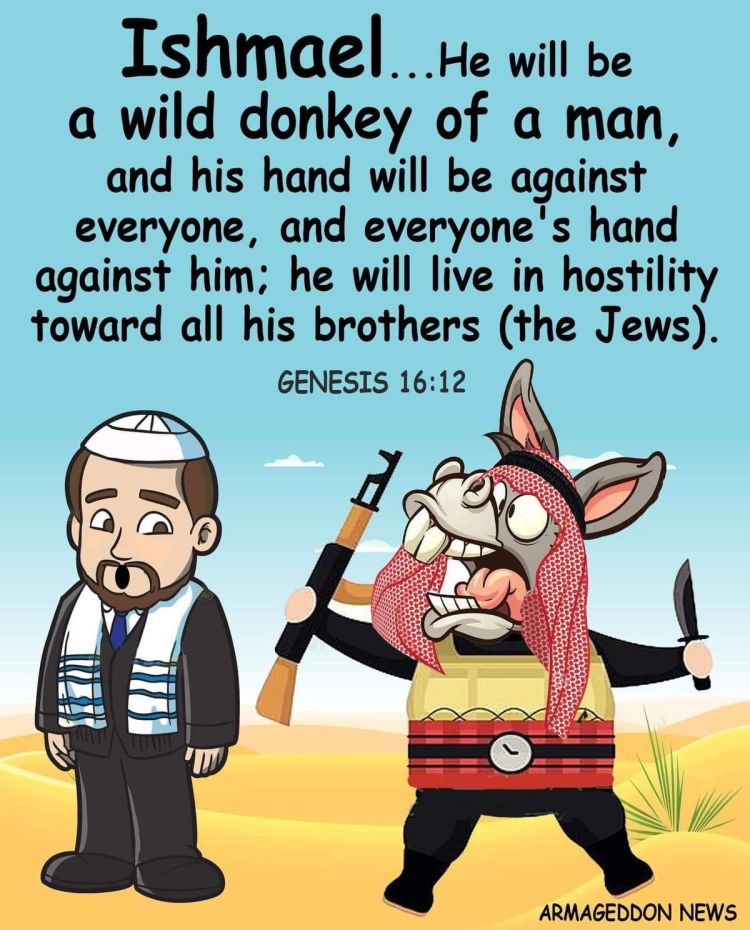
The angel of Adonai found Hagar in the desert and said to her: “Go back to your mistress and submit to her authority. I will greatly increase your descendants so that they shall be too many to count.” The angel of the Lord said to her further: “Look, you are pregnant, and you will give birth to a son; you are to call him Ishmael because Adonai has paid attention to your misery. “And he will be a wild donkey of a man, His hand will be against everyone, and everyone’s hand will be against him; living his life at odds with his kinsmen.” Genesis 16:10-12
Notice, the Lord stated that conflict would follow. The conflict would be between Isaac and Ishmael. Ishmael’s hand would be against everyone, and consequently, everyone would react against him and his descendants.
Also, God promised to make great nations of both Isaac and Ishmael. Isaac would be the father of Israel and Ishmael the father of the Arabs.
“And as for Ishmael, I have heard you; behold, I will bless him, and will make him fruitful, and will multiply him exceedingly. He shall become the father of twelve princes, and I will make him a great nation. But My covenant I will establish with Isaac, whom Sarah will bear to you at this time next year.” Genesis (17:20-21)
Sometime after Isaac was born, Abraham sent Hagar and Ishmael away. They went into the desert to live.
The Middle East conflict was prophesied in Genesis. The conflict is between family members, the descendants of Isaac and the descendants of Ishmael. It is the result of Sarah trying to accomplish the Lord’s will in her own way.
When Islam emerged in the 7th century under the prophet Muhammad, it self-consciously positioned itself as a “correction” to the Judeo-Christian tradition. Muhammad traced his lineage through Ishmael and proclaimed Islam as the true continuation of Abrahamic faith.
The Ottomans retained religious significance as the custodians of the Islamic caliphate, a title granting them spiritual leadership over Muslims worldwide. The prospect of a European-dominated world order, with Christian empires ruling over Muslim populations, stirred ancient resentments.
World War One thus presented an opportunity for the Muslim world, led by the Ottoman Empire, to reassert itself against the Judeo-Christian West. The call to jihad in 1914 was a spiritual echo of Ishmael’s hand being “against everyone,” reigniting the ancient hostility prophesied in Genesis.
The clash between Islam and Judeo-Christianity during World War One was not a new phenomenon; rather, it was a continuation of an ancient conflict that began thousands of years earlier, with the rivalry between the descendants of Isaac and Ishmael.
The conclusion of World War One didn’t bring peace between Islam, Jews and Christians.
Muslims saw the carving up of the Ottoman Empire by Britain and France, through agreements like Sykes-Picot and declarations like the Balfour Declaration, as a betrayal. Western powers imposed new borders and installed regimes friendly to their own interests, disregarding indigenous people and their needs.
Particularly inflammatory was the British promise of a Jewish homeland in Palestine — a move that rekindled Muslim fears of Jewish and Christian domination in lands they considered to be their own.
The tensions that surfaced during World War One, continue to resonate today. The Israeli-Palestinian conflict, the rise of Islamic extremism, and the broader struggle between Islamic and Western civilizations are all echoes of the ancient rivalry between Isaac and Ishmael.
In the more than 45 years since the Middle East war of June 1967, there have been many peace plans and negotiations. So far they all have failed.
There is much confusion and disagreement today as to whether the Jews have a claim to the land they now possess, and to some they do not currently possess. The Muslims claim that they have the right to the land since they are sons of Abraham through his son Ishmael. The following scriptures in the Torah show clearly to whom God has given the land.
In (Genesis 12) the Lord said to Abram, “Get yourself out of your country, away from your kinsmen and away from your father’s house, and go to the land that I will show you.”
So, Abram went as Adonai had told him; and Lot went with him. Abram was seventy-five years old when he left Haran.He took his wife Sarai, his nephew Lot, and all the possessions they had accumulated, as well as the people they had acquired in Haran, and they set out for the land of Canaan, and they arrived there.
Abram traveled through the land as far as the site of the great tree of Moreh at Shechem. At that time, the Canaanites were in the land. The Lord appeared to Abram and said, “To you and your descendants I will give the land where you are residing–all the land of Canaan–as an eternal possession; and I will be their God.” (Genesis 17:8)
Then God said, (Genesis 17:19) “Your wife Sarah will bear you a son, and you will call him Isaac. I will establish my covenant with him as an everlasting covenant for his descendants after him.” Ninety-year-old Sarah had remained childless for so long that she doubted God’s promise. She thought she should help God out and asked Abraham to have a child with her maidservant, Hagar; – but Isaac was the promised son born to Abraham by Sarah.
And as for Ishmael, God also blessed him. He made him fruitful and gave him land and great wealth. But the Lord established His covenant with Isaac, who was born by Sarah.
Now let’s examine who owns the land. In (Leviticus 25:23) God said: “The land must not be sold permanently, because the land is mine and you reside in my land as foreigners and strangers.” God owns the land. He leased it to the Jewish people.
Canaan was bigger than the land Israel has today. It included Palestine, Lebanon, western of Jordan and parts of Syria. I mentioned this in my previous article, Israel’s Promised Borders – Standing with Israel. Israel today owns only about one third of it.
The term of the lease is not up to the Palestinians or Hamas. (Psalm 105) reminds us that “He remembers his covenant forever, the word He commanded to a thousand generations, the covenant He made with Avraham, the oath He swore to Isaac, and established as a law for Jacob, for Israel as an everlasting covenant; to you I will give the land of Canaan as your allotted heritage.”It is a one-state solution, and nobody has the right to change it to a two-state solution. God requires a one-state solution. He never said that Isaac and Jacob had to share it with their cousins.
Today Israel experiences terror on every side! The enemies conspire against her and plot to take her life. But Israel must trust in the Lord. He preserves those who are true to him, but the enemies He pays back in full.
(Genesis 12:3) says God will bless them who bless you and curse those who curse you; – that’s Israel and the Jewish people. In the seed of Abraham all families of the earth are blessed. That is why America needs to support a one-state solution.
Just recently the Saudi Crown Prince Mohammed bin Salman said that his kingdom would not recognize Israel without the establishment of a Palestinian state. Will the Trump administration join the demands of the Muslims in the Abraham Alliance? – Today America’s future hangs in the balance!!
The Bible warns what will happen to nations that try to divide the land.(Joel 3:2) “I will gather all the nations and bring them down to the Valley of Jehoshaphat. And I will enter into judgment with them there, on behalf of my people and my heritage Israel, because they have scattered them among the nations and have divided up my land.”
The Bible reveals the spiritual war behind it. Hatred towards the Jewish people is a recurring theme throughout the holy scriptures, manifesting in various forms and through numerous adversaries. The different books provide numerous accounts of nations and individuals who harbored animosity towards the Jews, often resulting in conflict, persecution, and attempts to thwart God’s plans for His people. In modern times it is called anti-Semitism. The term antisemitism was coined by Wilhelm Marr, who was looking for a scientific sounding term to replace the word “Judenhass”, or Jew hatred in German. The word describes hostility toward or discrimination against Jews as a religious, ethnic, or racial group.
In the Bible, Semites refer to the descendants of Shem, one of Noah’s sons, included in the genealogies outlined in the book of Genesis. It narrates that everyone on earth drowned except for Noah and his family and that all mankind descended from his three sons, Shem, Ham, and Japheth. The idea widely adopted by Christians, and to a lesser extent by Muslims and Jews is, that the three sons of Noah represented the ancestors of three major racial or linguistic groups. According to this interpretation, Ham was the ancestor of the dark-skinned peoples of Africa, Shem of the Hebrews and people with similar languages, and Japheth the ancestor of the Medes, Persians, Greeks, and other peoples who, many centuries later, came to be known as Aryans.
A Semite refers to a member of any group speaking a Semitic language, mainly Hebrew, Aramaic, and Arabic. These form a linguistic family that connects their cultures. When taking the linguistic approach, Arabs can’t be anti-Semites.
However, the Oxford English Dictionary defines anti-Semitism more narrowly as “prejudice, hostility, or discrimination towards Jewish people on religious, cultural, or ethnic grounds.” That is what is understood today, in simple terms – it is Jew-hatred.
But it was already there in ancient times. One of the earliest and most significant examples of hatred towards the Jews is found in the account of the Israelites’ enslavement in Egypt. The Pharaoh, fearing the growing number of Israelites, subjected them to harsh labor and attempted to suppress their population.
The Amalekites are another notable enemy of the Jews, known for their unprovoked attack on the Israelites shortly after the Exodus.
In the Book of Esther, Haman, an official in the Persian Empire, epitomizes the deep-seated hatred towards the Jews.
In medieval times, the Romans destroyed the Jewish Temple.
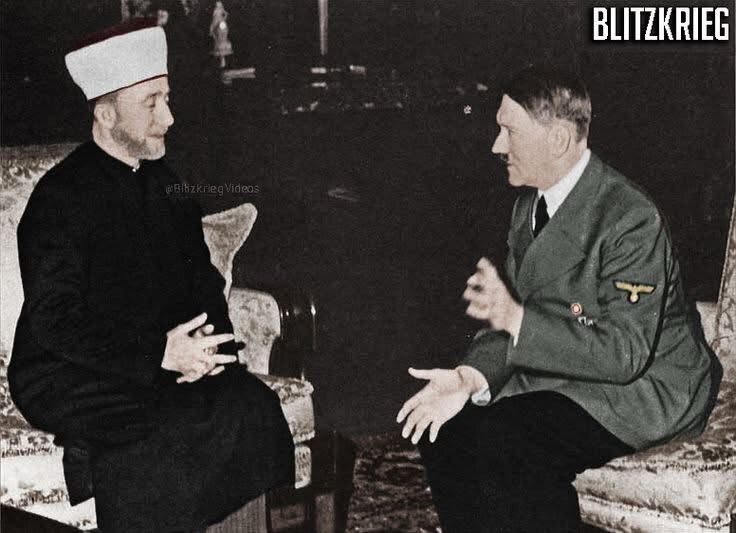
Arab leaders have repeatedly made clear their animosity toward Jews and Judaism. When Hitler introduced the Nuremberg racial laws in 1935, he received telegrams of congratulation from all corners of the Arab world. Later, during the war, one of his most ardent supporters was the Mufti of Jerusalem. During the Holocaust six million Jewish men, women, and children and millions of others were killed by Nazi Germany.
Ever since God brought the Jewish people into the world to fulfill His purposes, the devil tries to destroy God’s purposes.
America is still the greatest friend of the Jewish people and the nation of Israel in modern times. But that seems to be changing. When crowds chanted, “Death to Israel”, and “from the river to the sea, Palestine shall be free”, the demonstrations were not limited to Islamic lands or even to Europe. They could be found all over the United States. For the first time, hatred for Israel was being mainstreamed in American culture.
This has been illustrated in the Democratic Party. In 2017, Democrats constituted a pro-Israel party. But now, just 8 years later, the Democrats constitute a pro-Palestinian party.
Yet it’s not only on the left, but on the right as well. The far extreme has become increasingly brazen in its anti-Israel, anti-Jewish or anti-Semitic rhetoric. Even conservative circles are joining in. Tucker Carlson and Candace Owens are blaming the Jews and Zionism for the world’s evils. The world’s oldest hatred continues even today.
Though it is a stunning development, it should not shock us – as the Bible foretells that in the last days all nations will come against Israel.
Those who have Jewish friends know that they just celebrated their New Year’s Day, called Rosh Hashanah. The New Year season lasts through Yom Kippur (the Day of Atonement), the most solemn day of the Jewish year.
Rosh Hashanah marks the birthday of the universe, the day G‑d created Adam and Eve, which this year took place 5786 years ago.
In the beginning, calendars were lunar-based because moon phases were easy to measure. The Hebrew calendar, also known as the Jewish calendar, is a lunisolar calendar. It consists of 12 months, with an extra month added every few years to align with the solar year. The dates of God’s appointed feasts are recorded on that calendar. The Bible calls these the Moadim – the Lord’s Appointed Times (see Leviticus 23). They are not just historical festivals, but divine appointments on His calendar.
Most of the world today uses the Gregorian calendar, introduced by Pope Gregory XIII in 1582. It is a solar calendar that consists of 12 months and includes a leap year every four years, with specific exceptions for centennial years. It starts with the birth of Christ, 2025 years ago.
Rosh Hashana this year began at sundown on September 22 which started a period of reflection and repentance -also known as the Days of Awe – which will end on Yom Kippur at sundown on October 2. These days are marked by the sounding of the shofar, proclaiming God‘s Kingship.
Is there a special meaning for the year 5786?
Hebrew numbers are represented using the letters of the Hebrew alphabet, where each letter has a specific numeric value.5786 is written Tav–Shin–Peh–Vav(תשפ״ו).Each letter carries a meaning: Tav is covenant and completion. Shin is fire and refining. Peh is the mouth and proclamation. Vav is the nail or hook that connects (Source: Hebrew Dictionary).Put together, they point to a year of truth spoken boldly, promises fulfilled, and heaven and earth joined by God’s hand. This is the year of a divine hook that connects heaven with earth.
The Talmud describes how, on the holiday of Rosh Hashanah, three books are opened before God: one for the righteous, one for the wicked, and one for the intermediate. The righteous, the Talmud goes on to explain, are inscribed in “the book of life.” Man however cannot be righteous, without his sins being forgiven.
The Lord is calling His people to prepare, to awaken, and to align with this divine connection in 5786.
Today, many young people believe that “Palestine” was a country that belonged to Arab Muslims. Most of the media supports that claim. They think that the Jews came from Europe in 1948 and occupied or stole their land.
That –, of course is a lie. Universities, influenced by Qatari money and liberal antisemitic professors are brainwashing the youth to believe this lie.
They do not know or believe the true history.
The Hebrew Bible offers a narrative of Israel’s origin. According to the text, Israel’s origins can be traced back to Abraham, the father of Judaism (through his son Isaac). Abraham’s descendants were enslaved by the Egyptians for hundreds of years before settling in Canaan, which is approximately the region of modern-day Israel. The land was explicitly promised to Abraham and his descendants in (Genesis 15:18-21): “On that day the LORD made a covenant with Abram, saying, ‘To your descendants I have given this land, from the river of Egypt to the great river, the Euphrates.'” This promise is reiterated to Isaac (Genesis 26:3) and Jacob (Genesis 28:13-15).
The word Israel comes from Abraham’s grandson, Jacob, who was renamed “Israel” by the Hebrew God in the Bible. Through Abraham, Isaac and Jacob came the Twelve Tribes of Israel (Judah, Joseph, Benjamin, Dan …) and they inhabited the land God gave them.
The biblical history of Israel is dramatic. After the glorious Davidic Kingdom around 1,000 BC the tribes of Israel gradually fell away from their God and because of their disobedience the land came under different rulers. For 2000 years, Assyrians, Babylonians, Persians, Greeks and Romans ruled over the region.
After the crucifixion of Jesus, the Jews rebelled against the Romans in the Bar Kokhba Revolt. Subsequently, the Roman emperor Hadrian destroyed Jerusalem and murdered about a million Jews. He burned down the Temple and changed the name of Israel into “Syria Palestina” to insult the Jews and disconnect them from the land.
Later the Ottoman Turks ruled over the region before the British called it “the mandate of Palestine”. Thirty years later they issued the Balfour declaration to establish a Jewish state in „Syria Palestina”.
Even though many Jews were dispersed from the land for years, there has always been a remnant of Jews-living in the land. Finally, after 2000 years, after Jews were massacred in Europe, with God’s help, the Jews were able to return to their homeland. In 1948, Israel became a State in the Promised Land.
Recently I listened to a U-tuber, showing the Palestinian section of Hebron and lamenting how the poor Arabs had to suffer under the Israeli occupation. She didn’t bother to visit the cave of the Patriarchs, where Abraham, Isaac, and Jacob are buried.When I reminded her that Hebron was the capital of Israel prior to Jerusalem becoming the eternal capital, and that during the first seven years of his reign, King David ruled from Hebron, she replied: “That was a long time ago.”
I told her, that for years, the small community of 800 Jews in the ancient city of Hebron lived in peace with their Arab neighbors. But, on the night of August 23, 1929, Hebron turned into a city of terror and murder as the Arab residents led a rampaging massacre against the bewildered and helpless Jewish community. By the time the massacre ended, 67 Jews lay dead – their homes and synagogues destroyed – and a few hundred survivors were relocated to Jerusalem. The aftermath left Hebron barren of Jews for the first time in hundreds of years.
How could this happen if there were no Jews living in Israel before 1948? No answer. Her Arab friends didn’t tell her about that.
But as if that were not enough, to this day, the antisemites have not left the Jews alone. They want to murder them in their own land and kill them around the world.
The “Palestine and Palestinian” movement is nothing but a fraud and distortion of hand. It is a weapon and excuse by the same antisemites to murder innocent Jews. According to Palestinian historian Muhammad Y. Muslih, during the entire 400-year period of Ottoman rule (1517-1918), before the British set up the 30-year-long Palestine Mandate, “There was no political unit known as Palestine.” The deliberate creation of the “Palestinian people” as a discrete entity in 1967, and the political group known as the Palestine Liberation Organization (PLO) in 1964 was for the sole purpose of destroying a sovereign and legally mandated Jewish state. Historically, the Palestinian “desire for statehood” and “need for liberation” was invented in large part by the Soviet Union. It is no coincidence that the blueprint for the PLO Charter was drafted in Moscow in 1964. – Palestinians are an invented people.



 Standing with Israel