
The roots of Halloween go back to Samhain a pagan religious festival originating from an ancient Celtic spiritual tradition. Ancient Celts celebrated Samhain as the most significant of four quarterly fire festivals, taking place from October 31 to November 1 to welcome in the harvest and usher in “the dark half of the year.”
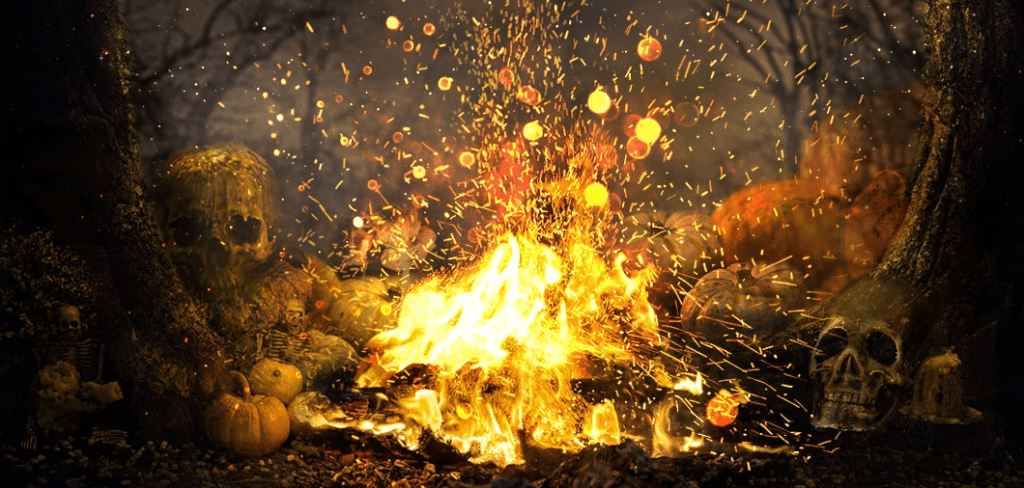
After the harvest work was complete, celebrants joined with Druid priests to light a community fire using a wheel that would cause friction and spark flames. The wheel was considered a representation of the sun and used along with prayers. Cattle were sacrificed, and participants took a flame from the communal bonfire back to their home to relight the hearth.
Celts believed that the barriers between the physical world and the spirit world break down during Samhain, allowing interaction between humans and spirits of the Otherworld. Because the Celts believed that the barrier between these worlds was breachable during Samhain, they prepared offerings that were left outside villages and fields for their ancient Celtic gods. Across the entire Celtic world, archaeological facts claim that there are more than 360 Celtic mythology deities.
Early texts present Samhain as a mandatory celebration lasting three days and three nights where the community was required to show themselves to local kings or chieftains. Failure to participate was believed to result in punishment from the gods, usually illness or death.
As the Middle Ages progressed, so did the celebrations of the fire festivals. Bonfires known as Samghnagans, which were more personal Samhain fires nearer the farms, became a tradition, purportedly to protect families from fairies and witches.
Carved turnips called Jack-o-Lanterns began to appear, attached by strings to sticks and embedded with coal. Later Irish tradition switched to pumpkins.
As Christianity gained a foothold in pagan communities, church leaders attempted to reframe Samhain as a Christian celebration. In the 9th century, Pope Gregory declared the celebration All Saints’ Day, on November 1. All Souls’ Day would follow on November 2. October 31 became known as All Hallows Eve, or Halloween, and contained much of the traditional pagan practices before being adopted in 19th-century America through Irish immigrants bringing their traditions across the ocean.
Halloween, as we know it today, is a modernized version of the Druidic festival of the dead.
Many people say “Happy Halloween,” without realizing the import of what they are saying because they do not understand the history of holiday.
Knowing the sinister roots of this festival, I don’t want to have anything to do with this tradition.
 Standing with Israel