
When your life is dominated by something to the point where you almost lose control, that is tyranny. It comes in various forms; political, social, financial, religious, emotional, all these and more can become tyrannical.
Information technology is continuing to leap forward; biotechnology is beginning to provide a window into our inner lives—our emotions, thoughts, and choices. We already use voice and facial recognition and speak to Alexa or Siri.
Kids today are introduced at an early age to the fast-growing field of robotics. Schools stoke your child’s passion for engineering with fun, hands-on robotics courses. Since robots are physical devices, learning about robotics is a good way for kids to use their software development skills (like Scratch and Python) to program hardware.
Major advances aided by surgical robots have been remote surgery, minimally invasive surgery, and unmanned surgery. Due to robotic use, the surgery is done with precision, smaller incisions, decreased blood loss, less pain, and quicker healing time. Articulation beyond normal manipulation and three-dimensional magnification help to result in improved ergonomics. Due to these techniques, there is a reduced duration of hospital stays, blood loss, transfusions, and use of pain medication. The existing open surgery technique has many flaws such as limited access to the surgical area, long recovery time, long hours of operation, blood loss, surgical scars, and marks.
Elon Musk envisions to control machines with just the power of thought. To that end, in July 2019, Musk and his team revealed that they had developed ultrafine ‘threads’ that can be woven into your brain to listen in on your neurons. His company has also built a robot that can perform the delicate surgery, under the supervision of a neurosurgeon. ‘Neuralink’ is a microchip that is surgically implanted in your brain, allowing you to connect with and even manipulate computers.
Ordinary people may not understand artificial intelligence and biotechnology in any detail, but they can sense that the future is passing them by.
Lots of mysterious terms are talked about at technology conferences and government think tanks, involving—globalization, blockchain, genetic engineering, AI, machine learning—and many people, including myself, do not understand these terms.
The fear of machines pushing people out of the job market are, of course, nothing new, and in the past such fears proved to be unfounded. But artificial intelligence is different from the old machines. In the past, machines competed with humans mainly in manual skills. Now they are beginning to compete with us in cognitive skills. And we don’t know of any third kind of skill—beyond the manual and the cognitive—in which humans will always have an edge.
At least for a few more decades, human intelligence is likely to far exceed computer intelligence in numerous fields. Hence as computers take over more routine cognitive jobs, new creative jobs for humans will continue to appear. Many of these new jobs will probably depend on cooperation rather than competition between humans and AI. Human-AI teams will likely prove superior not just to humans, but also to computers working on their own.
More than five years ago, World Economic Forum (WEF) founder Klaus Schwab, talked about fusing the physical, digital, and biological world, and about microchipping everyone. Once chipped, we won’t need to do a thing to reach the digital world. “It will be natural,” noted the host. – Schwab wants to change what it means to be human.
The topic of robot takeover has historically been confined to the pages of science fiction books. However, it’s become an increasingly popular hypothesis in recent years as technological progress has continued at record pace. In fact, some of the brightest minds in the world are lending credence to this idea. Both Elon Musk, founder of Tesla Motors, and renowned physicist Stephen Hawking have warned that an A.I.-dominated world is no longer a matter of “if”, but “when.”
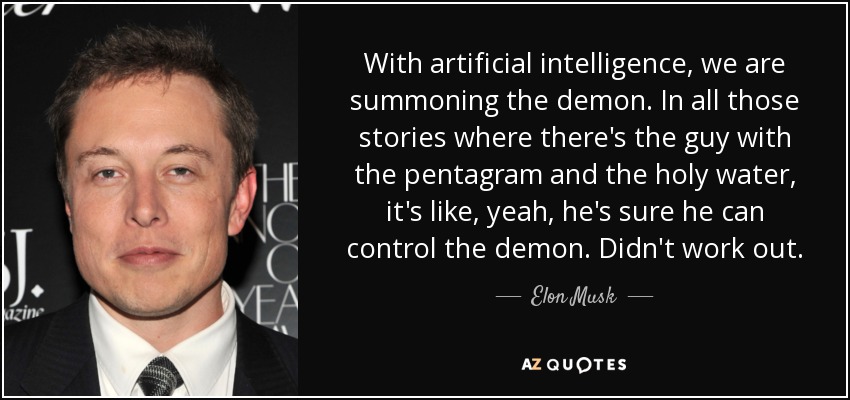
Think about it: for one, they are assuming that these ultra-intelligent creations would be interested in being worshipped as a deity. Isn’t that a massive gamble? What if they had violent or insidious tendencies? If this concept would be adapted by only a few people, they would be able to control the world. “With artificial intelligence, we are summoning a demon”, said Elon Musk, not a religious person himself.
At this point, it’s just as likely that an A.I. “Godhead” would see humans as an enemy; an obstacle that must be eliminated to make way for further technological expansion. The human race has spent eons creating gods…the difference is that in creating a technology god, there is a real possibility of such a god destroying free will. It sounds as if mankind is looking for another Golden calf. Remember, God said to not have idols.
The evil powers that be in this world are taking AI very seriously, as they know it will help create Satan’s kingdom here on Earth in a much more overt way.
 Standing with Israel