
Recently increased sunspot levels have led to higher frequencies of solar activity, such as solar flares and coronal mass ejections, which lit up the night sky. It was this solar activity that caused the beautiful phenomenon of spectacular auroras that were seen as far south as France and all over the United States. The northern lights – or the aurora borealis – are beautiful dancing waves of light that have captivated people for millennia. But for all its beauty, this spectacular light show is a rather violent event because energized particles from the sun slam into Earth’s upper atmosphere at speeds of up to 45 million mph. Luckily our planet’s magnetic field protects us from the onslaught.
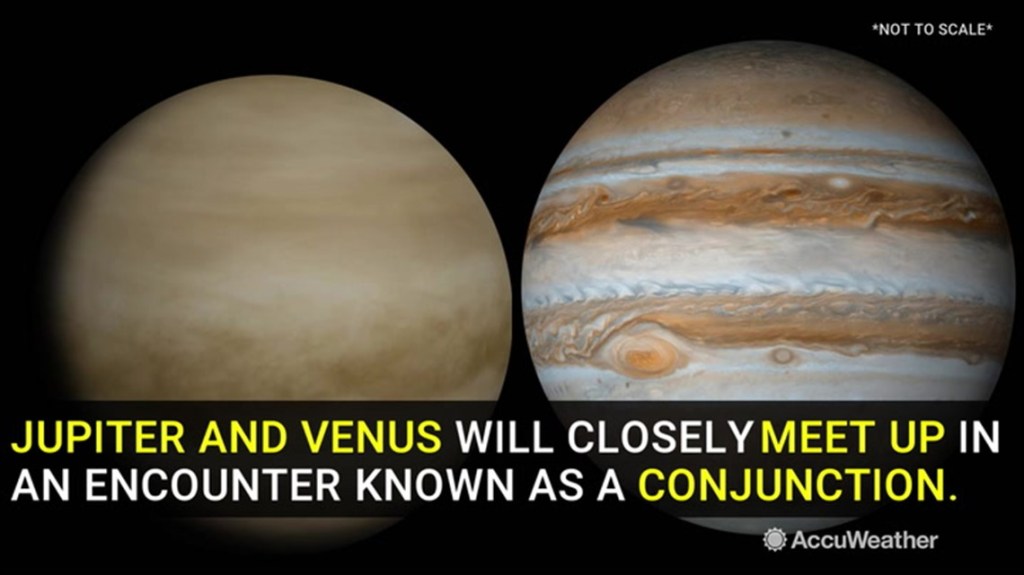
Last Wednesday, Jupiter and Venus appeared very close together in the night sky, with the two planets set to pass each other in what’s known as a conjunction. Conjunctions between planets happen frequently because the celestial bodies orbit around the sun in approximately the same plane as one another and trace similar paths across our sky. This conjunction was a striking spectacle to view.
Meteors, also known as shooting stars, are pieces of dust and debris from space that burn up in Earth’s atmosphere, where they can create bright streaks across the night sky. When Earth passes through the dusty trail of a comet or asteroid’s orbit, the many streaks of light in the sky are known as a meteor shower. Particularly large chunks of material can create an extra-bright fireball streak, but most meteors are still small enough to entirely burn up in Earth’s atmosphere. If a meteor makes it to Earth, it’s known as a meteorite. Before they hit atmosphere the objects are called meteoroids.
A hefty meteor weighing around the same as a grand piano recently entered Earth’s atmosphere above Texas on Feb.15, showering the surrounding area with smaller fragments. One of these meteorite chunks has already been recovered and could help reveal more about our cosmic neighborhood, experts say. This type of space rock is known as a fireball meteor because of the bright flash given off as it breaks apart, due to friction between the fast-moving object and the air in the atmosphere.
A dazzling beam of light was seen across the dark California sky at about 2:20 a.m. on Thursday morning: a sudden glimpse of a meteor that disappeared within seconds, leaving behind a glowing tail that was observed by people and security cameras from more than 100 miles around.
Genesis 1:14 tells us that the sun, moon and stars are signs to mark seasons, or appointed times, as well as days and years. These seasonal time changes occurred with the flood of Noah, the call of Abraham, the exodus, and the exile.
The Star of Bethlehem, appears in the nativity story of the Gospel of Matthew, where Magi from the East were inspired by the star to travel to Jerusalem. Astrology was widely used at the time in Babylon, it’s therefore plausible that they were astrologers.
For centuries, scholars have suggested the Star of Bethlehem may have actually been a “great conjunction” of bright planets. There was a conjunction between Jupiter and Venus recorded at that time. Because planets move in their orbits at different speeds, and are located at different distances, sometimes they appear to pass one another in the night sky and look like one bright star.
Most years have 12 full moons, but 2023 will have 13, with two — which are supermoons — happening in August. Supermoons are brighter and closer to Earth than normal and therefore appear larger in the sky.
Additionally, there will be two solar eclipses and two lunar eclipses in 2023. Something to look forward to. —More spectacular signs in the sky!
 Standing with Israel