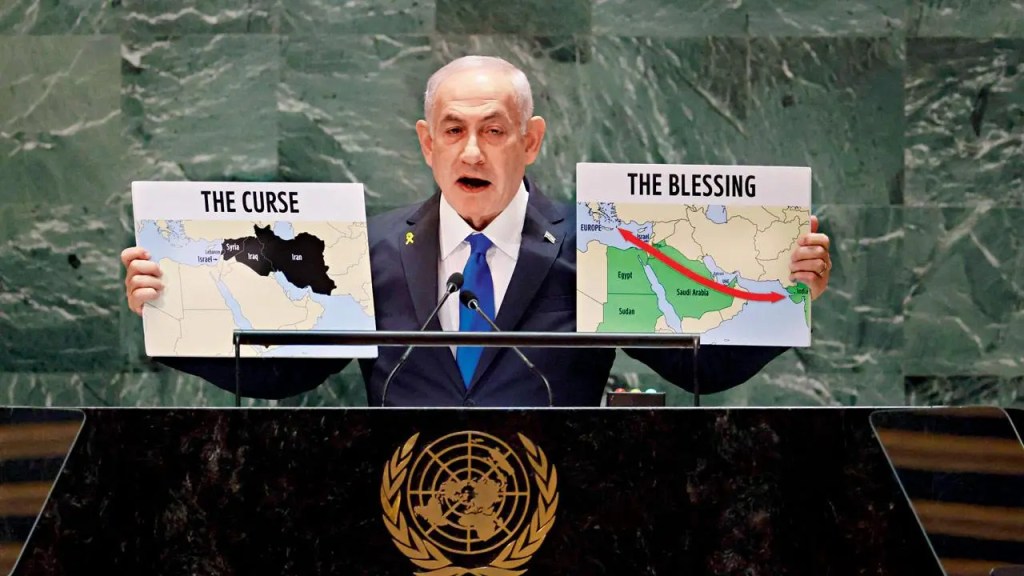
In his address to the United Nations General Assembly on Friday, Israeli Prime Minister Benjamin Netanyahu displayed a choice for the nations of the Middle East and the world, between the “blessing” of expanded regional normalization or the “curse” of Iran, its proxies and Oct. 7. He said that the world must choose between a “blessing” and a “curse” while he showed two maps, showing a group of countries as “The Curse” and another as “The Blessing”.
“Ladies and gentlemen, as Israel defends itself against Iran in the seven-front war, the line separating the blessing and the curse could not be more clear,” Netanyahu told delegates. The pair of maps — one showing a potential normalization corridor through the Gulf and the Middle East and the other showing the proliferation of Iran’s proxies. “On the one hand, a bright blessing, a future of hope,” he said. “On the other hand, a dark future of despair… Israel has made its choice. We seek to move forward to a bright age of prosperity and peace. Iran and its proxies have also made their choice. They want to move back to a dark age of terror and war.”
He said that the countries of the world must choose which side they will stand on.
Netanyahu argued that Israel’s wars against international terrorist groups are a fight against a common global enemy. He condemned those at the U.N. and elsewhere who he said have tried to cast Israel as evil and Iran and its proxies as good.
In the Bible, God explains His law in which obedience leads to blessing and disobedience leads to curses, which – in essence – are a reversal of God’s blessings. Deuteronomy11 introduces this law and details how it works. In Chapter 28 we find a detailed list of the different curses and blessings.
The book of Judges provides an example of how this law works. During that time the Hebrews lived among the Canaanites. They took their daughters for themselves as wives, and gave their own daughters to their sons, and served the Canaanite gods, ignoring Adonai’s commandment not to serve other gods. The book of Judges details that sin cycle which was followed by their cursing. After their repentance God delivered them through a judge. However, once the judge died, Israel would go back into a sinful lifestyle, resulting again in cursing. While the people of Israel were in obedience, God blessed them mightily, but He utilized various means to curse Israel whenever the sin cycle repeated.
The nation of Israel had a choice to make between life and death, blessing and cursing. Obedience would lead to the blessing of a prosperous life in the Promised Land, and disobedience would lead to the curses mentioned earlier, which led to oppression, death by various means, and ultimately exile away from the Promised Land. As modeled in the book of Judges, these curses would show the shortcomings of the people, resulting in a push for repentance and a restoration of their relationship with God.
One of the first promises in the Bible was given to Abram, whom God appointed to be a blessing to the whole earth. Not only did God tell this patriarch that he would receive a good land and have many children, but He also promised Abram, “I will bless those who bless you, and him who dishonors you I will curse” (Gen.12:1-3).
The nation of Israel serves as an object lesson to other nations and individuals. Which side will you choose? The side of the only true God of Israel or the side of other gods? Light or darkness?
The most important life-choice anyone will ever make is their response to this fundamental question: “Choose today, whom you will serve.” (Joshua 24:15)
 Standing with Israel