The Miracles of Hanukkah
In 175 BCE, a new ruler, Antiochus IV, ascended to the throne of Syria. As did many rulers, he added the title Epiphanes (“God Manifest”) to his name; but many people referred to him instead as Antiochus Epimames (“The Madman”).
Antiochus IV. took over Jerusalem and erected an altar to the pagan god Zeus in the Temple. He sent his Greco-Assyrian armies to Jerusalem to force the Jewish people to make a sacrifice to Zeus. The sacrifice was an unkosher animal – a pig -, desecrating the altar of the Holy Temple. Sadly, many Jews were compromising. Antiochus then ordered his soldiers to go from town to town to force all the Jews to sacrifice pigs. – But it all stopped when the Greco-Assyrian soldiers came to a Jewish town called Modi’in. While they were trying to force the Jews there to make a sacrifice to Zeus, a priest by the name of Mathattias said: “NO”. That inspired the rest of the Jewish onlookers so much that they turned on the Greco-Assyrian army and began to drive them out of Modi’in. Eventually more and more Jewish people joined the movement and advanced to conquer Jerusalem, where they recovered the Temple. Against all odds, these freedom fighters beat the entire army of Antiochus IV, – it was a great miracle – God delivered the many into the hands of a few. In 164 BCE they re-dedicated the Temple back to God, and that is where the name Hanukkah comes from. The Hebrew word Hanukkah ( חֲנֻכָּה ) means dedication. Derived from the root חָנַךְ (chanak), meaning “to dedicate” or “to initiate. The term “hanukkah” primarily refers to the concept of dedication or consecration. It is used in the context of dedicating a building, an altar, or other sacred objects to God and setting them apart for a holy purpose.
The Jews rebuilt the altar and lit the menorah with the remaining kosher oil they found, which was only enough to last for one day. Another great miracle happened, the Menorah stayed lit for another 7 days, a total of eight days, until they had a new batch of oil to keep the flame burning. The eternal light was symbolic of God’s presence among his people.
So, Hanukkah celebrates the dual miracle of fighting and lighting. It is therefore called the Feast of Dedication and the Festival of Lights. It commemorates the eternal God delivering his people. He is bigger than the circumstances that surround His people if they have faith to believe in Him. He delivered them from the Egyptians, from the Greeks, from the Nazis, so never lose hope! Faith and Hope is what the lights of the Hanukkah candles represent. The fact that we can take God at his word and believe for miracles.
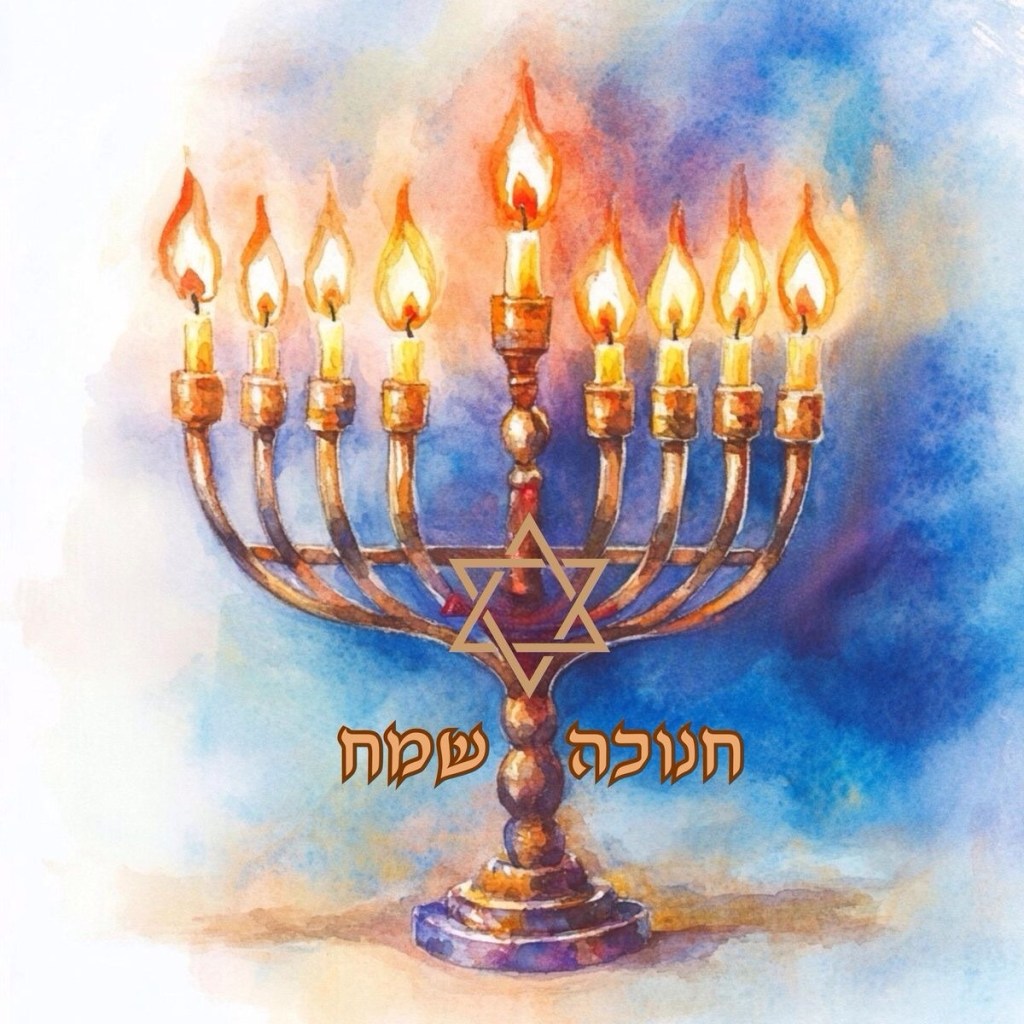
A Hanukkah menorah, or hanukkiah, is a nine-branched candle holder that is lit during the eight-days of Hanukkah. Eight of the nine branches hold lights (candles or oil lamps) that symbolize the eight nights of the holiday; on each night, one more light is lit than the previous night, until on the final night all eight branches are ignited. The ninth branch holds a candle, called the shamash (“helper” or “servant”), which is used to light the other eight candles. The candles remind us that God can win against all odds and therefore represent his deliverance and salvation.
Interestingly Hanukkah is not mentioned anyplace in the Tanach, but only in the New Testament. The apostle John wrote:” Then came Hanukkah in Yerushalayim. It was winter, and Yeshua was walking around inside the Temple area, in Shlomo’s Colonnade.” (John 10:22) As a Jew he was celebrating the Feast of Dedication with the Jewish people. Dedication is the English word of the Hebrew word Hanukkah. Note that Jesus did not celebrate Christmas but the Jewish holiday Hanukkah.
 Standing with Israel
Was Mark’s Gospel an intentional tool of Roman psychological warfare, or was it a Jewish counter-narrative meant to influence how different Jewish communities engaged with Rome?
Pie in the sky speculations attempt to foist as actual history propaganda stories of an imaginary Man-God & a zealous convert to Xtianity. Despite the clear language of the Torah that nothing in the Heavens, Earth, or Seas compares to the image of God or the prophet Bil’am’s explicit vision – God is not a Man.
Coptic revisionist history does not change speculative books of propaganda into actual history. The earliest surviving manuscripts of the Gospel of Mark written in Greek. Papias’s claim that Mark, originally written in Hebrew or Aramaic simply never substantiated by any physical evidence. This discrepancy highlights the challenges in relying solely on early testimonies. Simply due to the fact that no known agenda defines the purpose of those early works!
News travelled slowly in ancient times. Writing a detailed account like the Gospel of Mark would require more time than the immediate aftermath of the Temple’s destruction. The process of dating ancient texts often involves interpretations based on incomplete evidence. The News of the destruction of Herod’s Temple would by far have out shined the News of the Roman torture of a common criminal!
The floated speculation made by Xtian scholars that the Mark gospel written between AD 65 – 75 has no physical evidence – anymore. This revisionist history of the life and death of a Harry Potter – imaginary Jesus. Furthermore, the Roman war to put down the Jewish revolt, like the destruction of Herod’s Temple in AD 66 would have swamped the News Headlines!
Historians and scholars often work with incomplete evidence, leading to various theories and interpretations. The dating of ancient texts involves analyzing historical, literary, and contextual clues, which can result in differing scholarly opinions. Revisionist history perverts speculation and biased beliefs in God as the basis for truth! But this religious speculative interpretation, not the only kid on the playground.
What evidence we have does suggest that Mark’s Gospel – written in Greek, and the claim that it was originally in Hebrew or Aramaic is one of those early testimonies (like Papias’s) that has not been substantiated by physical evidence. The lack of an original manuscript in Hebrew or Aramaic definitely complicates the matter. To point out the flimsy argument to its face.
From a historical perspective, the fall of the Temple, a monumental event, and indeed. It would have garnered more attention from contemporary sources than the death of a single man—especially if that man was seen as a marginal figure at the time. A fine line between interpretation and assertion.
History and religious narratives can sometimes become entangled with belief systems, and how that can distort our understanding of past events. History, at its core, should strive toward objective and evidence-based possibilities. The reliability of early Christian sources like Irenaeus (c. AD 180) and Clement of Alexandria (c. AD 200) depends on how one evaluates historical testimony. While some of the earliest known religious Goyim voices commenting on the origins of the Gospels, reliability – debated due to their biased views toward Xtianity. Traditional church dating of the gospels serves Xtian narratives. Irenaeus wrote around AD 180, more than a century after mythical Jesus’ time. Clement of Alexandria is even later, writing closer to AD 200.
Both writers were engaged in theological battles, especially against Gnosticism. Some argue that their emphasis on apostolic authorship simply driven by the need to defend orthodoxy rather than strict historical accuracy. We do not have direct writings from Mark himself or from first-century figures confirming his authorship, only second-hand traditions which no courtroom would accept such hearsay evidence!
Courts reject hearsay because the person who originally made the claim, unavailable for cross-examination. Ancient history, much of what we know comes from later accounts. If we dismissed all second-hand testimony, we’d lose most of ancient history, including figures like Socrates, whose teachings come from Plato and Xenophon. Mythology defines the ancient Greek writings.
Challenging the idea that Mark’s Gospel was originally written in Hebrew or Aramaic—and even questioning its authenticity altogether—comes from different camps within biblical scholarship. The Greek syntax and grammar do not suggest a translation from Semitic languages. Mark’s Gospel includes Latinisms (Roman loanwords), such as centurion (kenturion in Greek) and denarius, indicating it was written for a Greek-speaking Roman audience. The use of Aramaic phrases (e.g., Talitha koum in Mark 5:41) suggests that the author was translating occasional words rather than the entire text being a translation.
Eusebius (4th century) quotes Papias, affirming that Mark wrote his Gospel based on Peter’s preaching, but he makes no reference to a Hebrew or Aramaic version which Papias (AD 110-140) claims. Some reasonable skeptics argue that Mark’s Gospel simply not based on historical events but rather a theological narrative invented by early Christians. They suggest Mark created a fictionalized Jesus, using Jewish scriptures (like Isaiah and the Psalms) as a template rather than actual historical events.
Figures like Richard Carrier argue that Jesus, originally understood as a celestial being and that Mark later invented a biography for him, shaping the Gospel as an allegory rather than historical record. Many accept that Mark contains some historical elements but argue that miraculous accounts, predictive prophecy, and resurrection narratives, simple later embellishments made by Xtians who loved fairy tail stories.
Paul as an Agent Provocateur: Instigating Civil War in Rome? Having lived in Rome he understood Roman weaknesses and political undercurrents. Like for example: Caesar worshipped himself as the son of God. Paul’s writings qualify also as political satire. Like Nigger Jim in Mark Finn who mocks King Solomon as the wisest of all men! The idea that the kingdom of God is not of this world fits precisely within Greek and Roman mythologies! Jewish religious authorities, specifically over the specific debate of an oven, where rabbi Eleazer got place into harem. Rabbi Eleazer called on a bat-kol, and the rabbis declared: the Torah does not come from heaven!
Mark’s Roman written Gospel aimed to promote disharmony between the Jews of Alexandria Egypt and the Jews of Judea. During the Bar Kakhba revolt the Jews of Axelandria did not join that revolt. This permitted the Roman legions to destroy both revolts piecemeal.
Chaos and anarchy defined the state of Judea during the first revolt against Rome. The discovery of the Dead Sea Scrolls conclusively proves these historical facts. If Mark were inciting Jewish-on-Jewish conflict, it would align with historical accounts that factions within Jerusalem were already fighting among themselves before Rome even breached the city walls.
Why does Mark’s gopels have Jesus say, “Render unto Caesar what is Caesar’s” (Mark 12:17)? This supports the premise that the gospel writings of Mark supported Jewish Civil War. The messiah narrative did emphatically split into strongly opposed Jewish factions! Jewish appeasers compare to post WWI British supporters of Chamberlain! Clearly the writings of Mark’s gospels opposed the war prone Zealots!
Divide and Conquer an old idea. Roman interests as well as Jewish interested preferred fighting one another while their enemies fought a Civil War. The Maccabees conducted this strategy successfully against the Syrian Greeks 150 years previous.
Roman emperors (especially Augustus) were deified as Divi Filius (Son of God). Paul’s reinterpretation of “Son of God” into a Jewish-messianic sense, could have been perceived by Rome as an indirect attack on Roman religious authority. If Paul mocked Caesar’s claim to divinity, it would qualify as political subversion—though disguised as religious teaching.
The comparison of Paul to Mark Twain’s Jim in Huckleberry Finn, that his theology contained coded humor and irony meant to subvert authority. Some scholars note parallels between Greek/Roman mythology and Paul’s spiritual kingdom concept, suggesting he tailored his message to resonate with Roman audiences.
Paul’s conflicts with Jewish religious leaders (especially over Torah authority) certainly widened the divide between Hellenistic Jews and traditional Pharisees. His message of a Torah-free Gospel was highly inflammatory—not only did it anger Judean Pharisees, but it also alienated Jewish nationalists who wanted a political Messiah. This played into Roman interests, whether Paul intended it or not.
Mark’s Gospel exacerbated Jewish factionalism, particularly between Alexandrian Jews and Judean Jews. Did Alexandrian Jews Refuse to Join the Bar Kokhba Revolt Because of Mark’s Influence? There is no direct evidence linking Mark’s Gospel to Alexandrian Jewish neutrality, but the timing remains intriguing. Alexandrian Jews far more assimilated & Hellenized, and less likely to support a militant Jewish messianic movement. If Mark’s Gospel circulated among them, emphasizing a suffering, non-political Messiah, it could have dissuaded them from joining the rebellion.
Josephus records that Jews in Jerusalem already experienced in killing each other before the Romans even arrived (Zealots vs. Priests vs. Sicarii). Mark’s Gospel portrays Jewish leaders as divided and corrupt, reinforcing Roman narratives that Jews were ungovernable. If Mark’s intention was to drive a wedge between Jewish factions, it would align with the Roman “divide and conquer” strategy.
Mark 12:17 (“Render unto Caesar what is Caesar’s”) suggests support for Roman rule and opposition to Zealot resistance. Jesus’ statement could be read as a message of appeasement. Encouraging Jews to cooperate with Rome, undermining Zealot ideology, and reinforcing the idea that the Messiah was not meant to be a political revolutionary.
The Maccabees used this Divide-and-Conquer Strategy against the Greeks—turning different Hellenistic factions against each other. Rome, a master of this strategy, pitting Jewish factions against each other: Sadducees vs. Pharisees, Zealots vs. Hellenized Jews, Priests who denied the Oral Torah vs. rabbis who taught the Oral Torah. If Mark’s Gospel helped weaken Jewish unity, it ultimately benefited Rome.
Paul’s personal motives remain unclear—was he a true believer, or a savvy political manipulator? Mark’s Gospel certainly reinforced factional divisions, whether by design or accident. The idea that Paul may have been an agent provocateur, knowingly exacerbating divisions within the Roman world to the benefit of Jerusalem, a compelling angle that aligns with historical Greek & Roman strategies of divide and conquer. Equally well known and embraced by Jewish Sanhedrin leadership which sent Paul to Rome to promote Roman Civil War prior to the outbreak of the great Jewish revolt.
The connection between Mark’s Gospel and Jewish factionalism—especially its potential impact on Alexandrian Jews’ neutrality during the Bar Kokhba revolt—also quite interesting. If the Mark gospel, indeed written to undermine Jewish resistance by promoting a passive, non-political Messiah, it would fit neatly within the broader Roman strategy of controlling subject populations by weakening internal unity. The historical backdrop of intra-Jewish conflict before the fall of the Temple, as recorded by Josephus, provides further support for the idea that Mark’s Gospel likely designed (or at least functioned) as a tool of division rather than unity.
If the Sanhedrin saw Rome’s internal divisions as a potential advantage—especially in the lead-up to the Jewish revolt—Paul’s role as an instigator could have been strategic. Given his Roman citizenship, education in Greek rhetoric, and ability to move between Jewish and Roman circles, he served as a well-positioned Sanhedrin asset, who introduced subversive ideas that could destabilize Roman unity.
This would parallel other historical examples where Jewish leadership attempted to manipulate larger imperial powers to their advantage—much like the Hasmoneans did with Seleucid factions during their own revolt. If the Sanhedrin sent Paul to Rome as a spy, with the purpose: to promote theological and ideological rifts, it would explain why his teachings so totally disruptive—not just among Jews but within the Roman elite as well.
Mark’s Gospel, then, could be seen as part of this broader game of influence, to pacify Jewish resistance (if pacifist pro-Roman) or to create ideological splits that kept Jews distracted among themselves (if existed a deeper Roman war-time strategy). The fact that Alexandrian Jews stayed out of the Bar Kokhba revolt, while Judean Jews fought Rome head-on, could suggest that differing religious narratives—possibly shaped by Mark—helped fragment Jewish unity.
This interpretation pits the writings of Mark against those of Paul. Neither not as a merely religious thinkers, but as active political partisans, in the geopolitical struggle between Rome and Judea. If the Sanhedrin had the foresight to recognize Rome’s internal tensions and employed Paul as the tip of their spear, it would entirely redefine his original mission. A political kabbalah concealed from shallow Goyim who simply read his letters at face value. Rather than being a rogue preacher or a sincere evangelist, Paul served the Sanhedrin Court in Jerusalem as an early example of ideological subversion—using theology to create divisions within Roman society.
This would mean his emphasis concerning a “kingdom not of this world”, a concealed way to undercut Roman religious authority, while his rejection of strict Torah observance like circumcision, could have been a means to fracture Jewish support for messianic Jesus nonsense. It also fits with his constant conflicts—both with Jewish traditionalists and with factions within early Christianity. His letters reveal a figure constantly navigating and exacerbating divisions, whether intentionally or as a by-product of his ideological agenda.
Mark’s Gospel, also exposed as a second layer of Roman counter-disruption. If written in Rome, it could have express Roman strategic interests (to pacify Jewish resistance by promoting a passive Messiah) or to define Jewish messianism in a way that created discord between Hellenized Jews and their Judean counterparts. The simple fact stands: The church behaves as if it has a lock and key monopoly over the mitzva of Moshiach; despite the Pauline declaration that Goyim not under Jewish common law.
The fact that Alexandrian Jews sat out the Bar Kokhba revolt while Judean Jews were crushed strongly suggests that competing messianic narratives—such as influenced by texts like Mark—which totally ignores the Torah Moshiach precedent of Moshe anointing Aaron with oil, which served as the basis of Shmuel who anointed both Shaul and David as Moshiach with oil. The gospel narratives all ignore the precedent of anointing all korbanot placed upon the altar with oil. It does not weigh the dedication through oil wherein the Moshiach sanctified to rule the oath brit chosen Cohen lands with righteous judicial justice as the faith of the Torah. Hence the gospel writers, not just Mark, instrumental in keeping Jewish factions divided. If true, this would mean early Christianity simply never just a mere religious movement, but part of a larger strategic game—a subversive ideological front in the struggle between Rome vs. Judea.
LikeLike